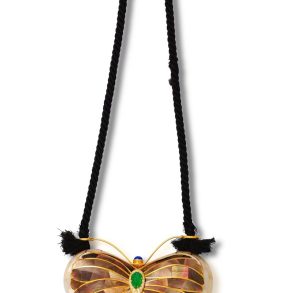



Emna Hussein’s handbags begin with a 3D printer and end with a paintbrush. The Fashion Trust Arabia finalist draws on Tunisian heritage, with details made from oyster shells and pine wood waste.
A Tunisian-Italian designer turning 3D-printed, plant-based plastic into sculptural handbags is among the three finalists for the Fashion Tech Award at Fashion Trust Arabia 2026. Emna Hussein, whose designs draw on traditional Tunisian jewellery, bridal garments and Mediterranean history, is nominated alongside Egypt’s Mesh-Mesh and Lebanon’s Girle. The winners will be announced on November 28th in Doha, with the award recognising emerging designers who bring technology into fashion.
Hussein founded her eponymous label in Cairo, where she developed her approach to digital fabrication before relocating to Houston. “Cairo is the place where EMNA HUSSEIN really became a brand rather than a series of experiments,” she tells SceneStyled. The move to the United States has presented a new challenge, requiring her to rebuild relationships with suppliers, establish production routines and adapt to an unfamiliar market while continuing to develop her collections.
 Before turning to 3D printing, Hussein worked in digital communications for major fashion, beauty and luxury brands in Paris, including Chanel, Thierry Mugler, Azzaro, Swarovski, and Clarins. Hussein then moved on to image consulting and started her own clothes brand in Tunis before taking a break to focus on 3D printing. Her brand debuted in December 2025.
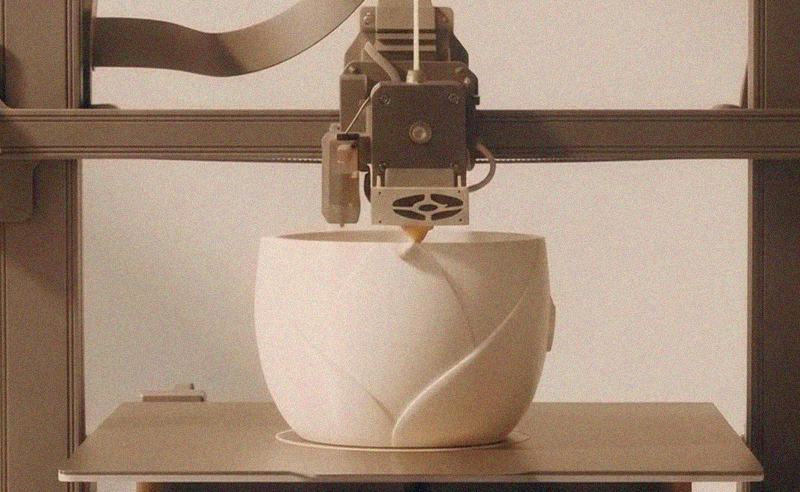
“The move to 3D printing was a practical response to frustrations with conventional fashion industry techniques,” Hussein tells SceneStyled. Complex curves, hollow volumes, continuous structures and modular pieces often required molds, tooling or production quantities that made little sense for an emerging independent label.
3D printing works from a file, without moulds and minimum orders, allowing Hussein to adjust forms by a few millimetres, print and test them, and make further changes without restarting the production process.
Hussein developed her technical skills through Elegoo With Her, a six-week programme launched in 2025 by Chinese 3D-printer manufacturer Elegoo. The initiative provided 30 women from 17 countries with printers, design software and training. During the programme, she developed Jasm-e, an experimental capsule inspired by memories of her childhood in Tunisia.
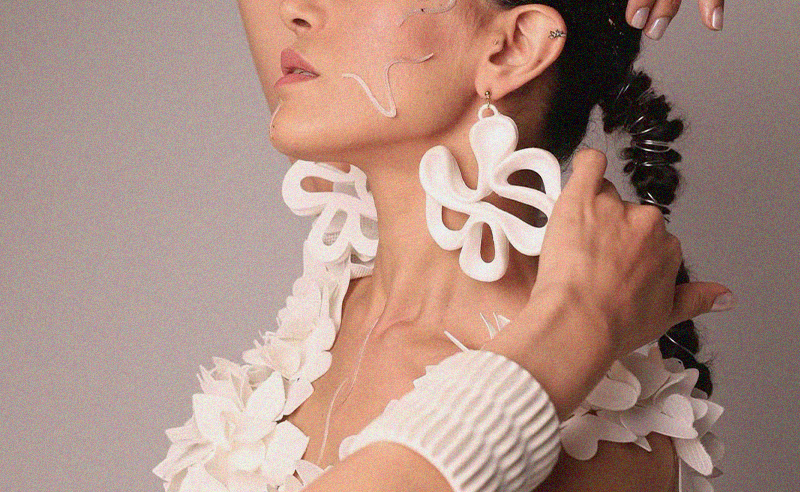
Jasmine flowers, the elaborate embroidery of the traditional fermla bridal waistcoat and chnechin bracelets became starting points for exploring three-dimensional forms. Rather than reproducing these objects literally, Hussein examined their construction: the overlapping petals of jasmine, the density and rhythm of embroidery, and the accumulation of bracelets that create movement and sound.
 The relaunched brand’s first collection, Act I: The Rebel Bride, got the Technical Award at the 2025 Cairo Design Award, Egypt’s annual design prize. The Halo and Petal bag designs have been created from floral elements and gold typical of local weddings, and then scaled up. “A rebel bride is a person who decides what to take, what to transform and how to wear it – it is not necessarily about rejecting tradition,” Hussein explains.
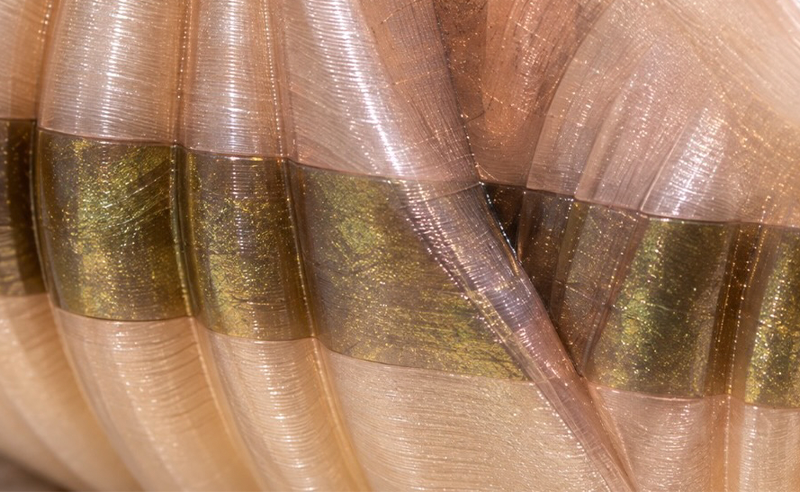
This collection has become the basis of the designer’s technique. Hussein combines rigid plant-based PLA for structural support with flexible materials that allow movement, before sanding, painting and applying pigments by hand to give the finished pieces a quality beyond that of a typical 3D-printed object.
The second collection of the designer, Act II: Amanakal, is based on the words from Amazigh languages of North Africa. Aman, meaning water, and akal, meaning earth or land. The collection’s Murice Crest Bag is inspired by the murex, a spiny sea snail that the Phoenicians, founders of Carthage in today’s Tunisia, crushed for their purple dye. “Murice is the Italian word for murex, and it is highly personal for me as it ties together my Tunisian and Italian heritage in one Mediterranean reference,” Hussein says.
 Rather than simply reproducing the shape of a shell, Hussein drew on its ridges, folds and asymmetry, particularly the way a rigid structure can appear fluid. The body of the bag is printed in bio-based PLA and its details are made of either oyster-shell or pine-wood composite, depending on the version. Each piece is then sanded, painted, and assembled by hand, incorporating the hand-woven Tunisian hayek, traditional fabric of women’s draping wraps, made of cotton or wool.
The printed parts start as filament, a thin strand of plastic wound on a spool, which the printer melts and lays down layer by layer. She buys it from specialist manufacturers and tests each new filament, as materials can behave differently during a 30- to 40-hour print than they do in smaller samples. PLA also has limitations concerning heat and rigidity, requiring a different approach from materials such as leather or metal.
Hussein produces her handbags on request, allowing her to manage inventory and refine designs without manufacturing large quantities. Nevertheless, she is careful not to present 3D printing as inherently sustainable. Printers consume electricity, failed prototypes generate waste and plant-based plastics are not necessarily biodegradable under ordinary conditions. For her, the advantages lie primarily in production flexibility, reduced dependence on moulds and the ability to make pieces according to demand.
With her Fashion Trust Arabia nomination, Hussein is bringing that combination of experimental technology and traditional craftsmanship to a wider audience. Her work proposes an approach to fashion in which digital manufacturing does not replace the artisan’s hand, but creates new possibilities for what it can make.
This post was originally published on this site be sure to check out more of their content.